Baccarat Rules: How to Play and Win
500% Deposit Bonus · Up to ₹1 LAKH · 18+
A baccarat hand runs in five stages, and the player decides only the first. After the chip is down, every card is drawn by rule. This page walks one hand through each stage, then shows the third-card chart and the bet that loses least.
Player · Banker · Tie
Stage 1: what are you actually betting on?
You back one of three outcomes: Player wins, Banker wins, or the two tie. Player and Banker are just the names of the two hands on the felt — you are not playing against the dealer and you never hold the cards yourself.
Many tables add side bets. The common pair bets — Player Pair and Banker Pair — pay 11 to 1 when that hand's first two cards share a rank, and carry a house edge of about 10.36% on eight decks. They settle on the first two cards and ignore who wins.
Stage 2: how are the cards counted?
| Card | Counts as |
|---|---|
| Ace | 1 |
| 2 to 9 | face value |
| 10, Jack, Queen, King | 0 |
Only the last digit of the total matters. A 9 and a 6 make 15, which is 5. A king and a queen make 0 — the worst hand in the game, called baccarat. No hand can go above 9, so there is no bust.
Stage 3: when does the hand stop at two cards?
If either hand shows 8 or 9 on its first two cards, that is a natural. Both hands stand, nobody draws, and the higher total wins. Two naturals of the same value are a tie.
About one hand in three ends here. If there is no natural, the Player hand acts first.
Stage 4: who draws a third card?
Player draws on a total of 0 to 5 and stands on 6 or 7.
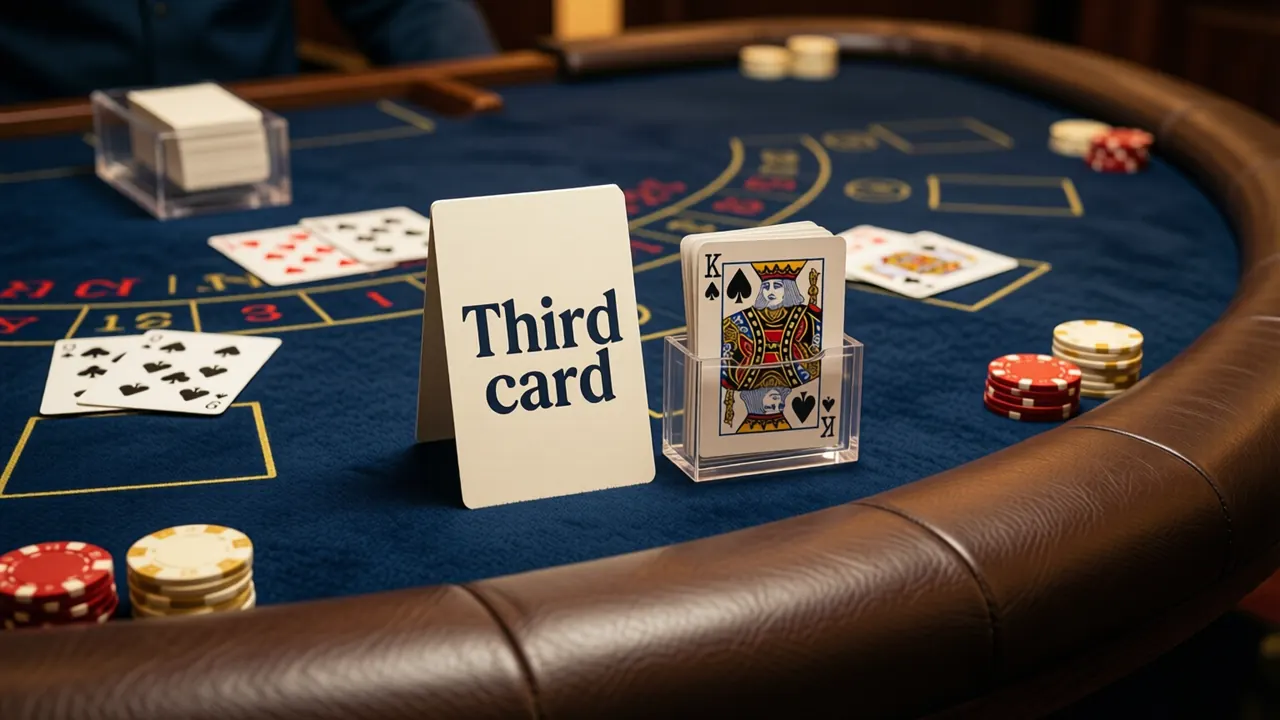
Banker then follows one of two paths. If Player stood with two cards, Banker uses the same simple rule: draw on 0 to 5, stand on 6 or 7. If Player drew, Banker looks at that third card and follows the chart below.
| Banker total | Banker draws when Player's third card is | Banker stands when it is |
|---|---|---|
| 0, 1, 2 | any card | — |
| 3 | anything except 8 | 8 |
| 4 | 2, 3, 4, 5, 6, 7 | 0, 1, 8, 9 |
| 5 | 4, 5, 6, 7 | 0, 1, 2, 3, 8, 9 |
| 6 | 6, 7 | 0 to 5, 8, 9 |
| 7 | never | always |
Nobody at a live table asks you to apply this. The dealer draws, and the screen shows the result. Knowing the chart is still useful: it is how you check that a hand on your screen was dealt correctly, and it explains why Banker wins more often.
Stage 5: how is the hand settled?
Higher total wins. Player bets are paid 1 to 1. Banker bets are paid 1 to 1 minus a 5% commission, so ₹1,000 on a winning Banker returns ₹950 profit. Tie pays 8 to 1, and on a tie the Player and Banker bets push.
Two worked hands, start to finish:
- Player 2 + 3 = 5, Banker 10 + 6 = 6. No natural. Player has 5, draws a 9: total 14, so 4. Banker has 6 and Player's third card was a 9 — the chart says stand. Banker 6 beats Player 4. A ₹400 Banker bet wins ₹380.
- Player 7 + 7 = 4, Banker 8 + King = 8. Banker has a natural. Both stand at once. Banker 8 beats Player 4 before anyone draws.
How do you win at baccarat?
You cannot change the cards, so "winning" means choosing the bet that costs least while you play. On eight decks the house edge is 1.06% on Banker, 1.24% on Player and 14.36% on Tie at 8 to 1. Banker is the cheapest bet on the table; Tie is the most expensive.
| Bet | Wins | Loses | Ties (push) | House edge |
|---|---|---|---|---|
| Banker | 45.86% | 44.62% | 9.52% | 1.06% |
| Player | 44.62% | 45.86% | 9.52% | 1.24% |
| Tie (8 to 1) | 9.52% | 90.48% | — | 14.36% |
Three habits follow from those numbers. Back Banker if you want the lowest cost per hand. Leave Tie and the pair bets alone unless you accept paying ten to fourteen times more for the excitement. And set the session stake before you sit down, because the edge is small per hand but adds up across hundreds of them.
What does not work: betting systems that double after a loss, and reading streaks off the scoreboard. A Martingale run on Banker still pays the same 1.06% on every chip; it just stacks the losses into one large hand. The shoe has no memory, and past hands do not change the next one.
18+ only.